
Angle-Bearing
Angle Rigidity with Bearing-Only Constraints [1]
Introduction
This work is founded on the recognition that pairs of bearing measurements originating from the same robot define angles independently of a coordinate frame. Contrasting with infinitesimally bearing-rigid frameworks, where individual bearings are maintained, infinitesimally shape-similar frameworks, are invariant to translation, rotation, and uniform scaling when the angles of the framework, or, equivalently, the inner-products of bearing pairs as discussed in this work, are maintained.
Preliminaries
Graphs and Frameworks
Frameworks for which any of the vertex positions are the same are referred to as degenerate frameworks. For frameworks in which the positions of the vertices are functions of time, the framework is denoted
Restricted to the plane, the following definitions, exemplified in Figure 1, are relevant to the results on planar frameworks in Sections: Triangulations and V. TODO
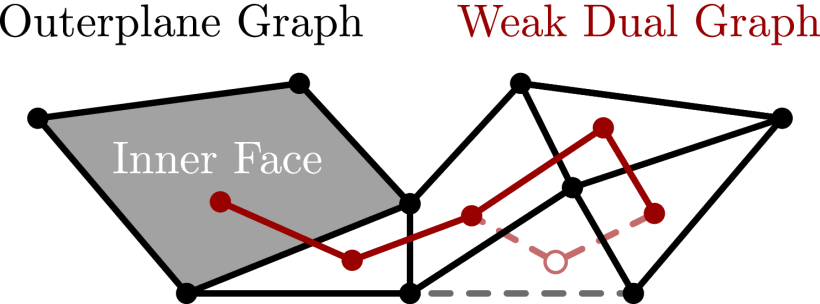
Definition: planar
A graph
In other words, plane graphs are frameworks
Definition: faces
The faces of a plane graph are the arc-wise-connected open sets partitioned by the embedding of the edges and vertices.
The outer face of a plane graph is the only unbounded face of the plane graph; all other faces are inner faces as depicted in Figure 1. The boundary of a face is the boundary of the associated open set, and faces are adjacent if their boundaries share an edge. The degree of a face is the number of adjacent faces.
Definition: outerplane graph
An outerplane graph is a plane graph for which all vertices lie on the boundary of the outer face.
The adjacency of the faces of a plane graph is described by the weak dual graph, defined as follows.
Definition: weak dual graph
The weak dual graph of a plane graph is the geometric dual graph, in which vertices correspond to faces of the plane graph and edges correspond to adjacency of the faces, less the vertex corresponding to the outer face.
Finally, a labeled graph is denoted
Affine Sets
The set
An isometric transformation of
Lemma 1
Let
Notation
The rank of a matrix is written as
Infinitesimal Shape-Similarity
In this section, infinitesimal shape-similarity is presented as a tool to describe the types of formations that can be achieved by maintaining the relative angles between robots.
- Beginning in Section: Infinitesimal Shape-Similarity, infinitesimal shape-similarity is defined.
- In Section: Shape-Similarity Matrix, the shape-similarity matrix, the primary tool for characterizing frameworks for infinitesimal shape-similarity, is developed.
- Finally, in Section: Assessing Frameworks for infinitesimal Shape-Similarity, the nullspace of the shape-similarity matrix is examined, yielding a rank condition on the shape-similarity matrix for assessing frameworks for infinitesimal shape-similarity.
Definition of Infinitesimal Shape-Similarity
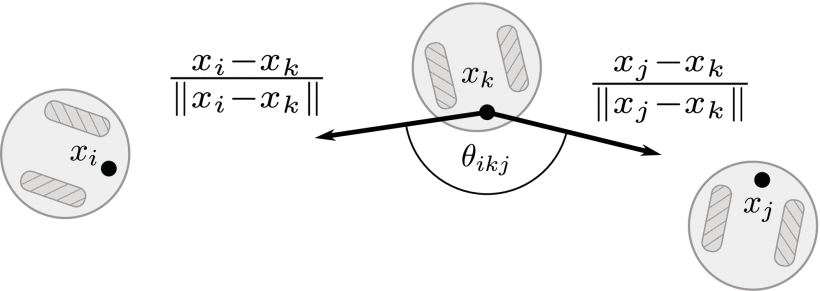
Consider a framework
- As with infinitesimal bearing-rigidity, the edges of
represent interrobot bearings; however, pairs of bearings, rather than the bearings themselves, are the quantities of interest in the study of infinitesimal shape-similarity.
Having introduced the angles of
Definition: angle-consistent motions
Infinitesimal motions
Of particular interest are angle-consistent infinitesimal motions that preserve the shape of
Definition: infinitesimally shape-similar
The framework
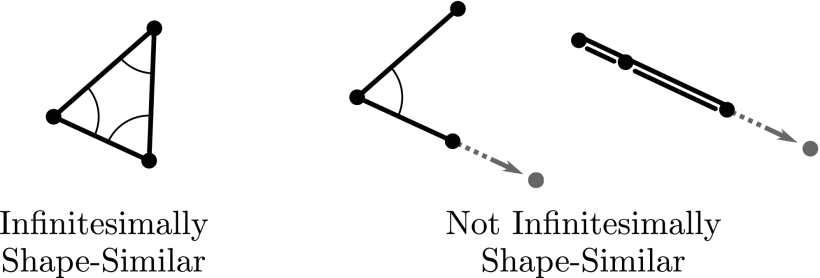
Infinitesimal shape-similarity, as defined in Definition above, requires that all angle-consistent motions of the framework be shape-preserving, which is a property that depends on the underlying graph topology and does not hold for frameworks at large; for example, consider the frameworks of Figure 3.
Furthermore, in order for frameworks to be infinitesimally shape-similar, the angles between vertices in the framework must be defined; thus, the frameworks under consideration must have at least 3 vertices and not be degenerate. The following subsections develop analytical tools to determine whether a given framework is infinitesimally shape-similar.
Shape-Similarity Matrix
This subsection develops the shape-similarity matrix, the primary tool for investigating the infinitesimal shape-similarity of a given framework. To begin, consider angle-consistent motions of
Proof:
Details of Proof
Suppose
Now, suppose
By Proposition 1, the time derivatives of the cosines of the angles of an angle-consistent framework are zero. Exploiting this fact, the structure of the shape-similarity matrix is revealed by examining the time derivative of the cosine of an arbitrary angle
Because it depends only on
where
Repeating this process for all
where:
denotes the elementwise cosine of the vector , is the shape-similarity matrix, is a diagonal matrix of positive scalars associated with rows of .
Each row of the expression in
where
where
The expression in
**Remark** 1
Consider
Assessing Frameworks for Infinitesimal Shape-Similarity
This subsection develops tools for assessing arbitrary frameworks for infinitesimal shape-similarity; examination of the nullspace of the shape-similarity matrix is central in this development. Consider the following theorem, which follows from the construction of the shape-similarity matrix.
Theorem 1
Infinitesimal motions
Proof:
Details of Proof
Suppose
From Theorem 1,
Definition: oriented
The points
Note that
As demonstrated shortly, oriented frameworks facilitate examination of
The following theorem can now be stated.
Theorem 2
Let
- Using the definition of oriented frameworks, the linear independence of the basis vectors is established in the proof of Theorem 2, which facilitates the determination of the nullity of the shape-similarity matrix
Proof:
Details of proof
To prove Theorem 2, the proposed basis vectors are first shown to be in
To show that each proposed basis vector lies in the nullspace of the shape-similarity matrix of
thus,
thus,
which follows from the skew symmetric property of
Having established that each of the proposed basis vectors lies in
Now consider linear independence of the vectors
Because of the sparse structure of
To show linear independence of
Linear independence of the vectors
The Kronecker product repeats this effect for each vertex position in
Suppose that some of the nonzero vectors of
From the sparse structure of
Now, consider linear independence of the vectors
Because of the sparse structure of
Having demonstrated linear independence of the basis vectors in Theorem 2, the proof can be completed.
- The vectors
correspond with translations; - The vector
corresponds with uniform scaling; - The nonzero vectors
, correspond with rotations.
By Definition of infinitesimally shape-similar, if
Having found a basis for the nullspace of the shape-similarity matrix of oriented frameworks, the following statements complete the analysis by first proving the existence of isometries that orient arbitrary frameworks and then proving invariance of
Proposition 2
Let
Proof:
Details of Proof
By construction,
As an example for Definition of oriented and Proposition 2, consider a framework of 2 vertices in the plane; by Proposition 2, an isometry exists that translates and rotates the vertices such that they are oriented along the horizontal axis.
Lemma 2
The nullspace of the shape-similarity matrix is invariant to isometric transformations.
Proof:
Details of Proof
Let
Thus, the time derivative
Proposition 2 and Lemma 2 support the following corollary.
Corollary of Theorem 2
Let
Proof:
Details of Proof
By Proposition 2, there exists an isometric transformation between
The results in Theorem 1 and Corrollary of Theorem 2 facilitate understanding of the available motions of multirobot teams maintaining angles and underpin the design of the formation-control strategies of Section V TODO; furthermore, these results yield a rank condition for evaluating frameworks for infinitesimal shapesimilarity.
Theorem 3
The framework
Proof:
Details of Proof
The necessary and sufficient condition of Theorem 3 is proved for 3 cases of the dimension of the affine hull of the vertices of the framework.
- Let
be a framework with . Such a framework is degenerate; it is not infinitesimally shape-similar, and the shape-similarity matrix, and thus the rank of the shape-similarity matrix, is undefined and does not satisfy . - Let
be a framework with ; the corresponding shape-similarity matrix is a matrix of zeros. By Theorem 1, all infinitesimal motions of the framework are angle-consistent, so is not infinitesimally shape-similar; furthermore, and does not satisfy . - Consider frameworks
with . The nullity of the shape-similarity matrix is the number of basis vectors for . Theorem 2 and Corrollary of Theorem 2 present such a basis, and as a direct result, a framework is infinitesimally shape-similar if and only if
where from the proof of Theorem 2, and the extension to unoriented frameworks in Corrollary 2.1, there are
The following corollary to Theorem 3 is presented for frameworks whose affine hull has sufficient dimension.
Corollary of [Theorem 3](#thm-3)
Let
Proof:
Details of Proof
The rank condition in
The rank conditions in Theorem 3 and Corollary of Theorem 3 are important tools when analyzing frameworks for infinitesimal shape-similarity, which will be demonstrated in Section: Triangulations where the rank of the shape-similarity matrix is examined explicitly to evaluate a class of frameworks for use in formation control. Beyond their utility in this example, the rank conditions enable further understanding of the significance of the framework embedding. As suggested in Remark 1, the particular embedding of
Definition: pathological
A framework
and nonpathological otherwise.
- pathological defined in other research described frameworks for which any vertices were collocated or collinear, while its definition here is defined in terms of the rank of the shape-similarity matrix and describes frameworks that do not achieve infinitesimal shape-similarity due to the particular configuration of the vertices.
As a canonical example, a framework of collinear vertices, such as that shown in Figure 3, is pathological because its shapesimilarity is a matrix of zeros as noted in the proof of Theorem 3. The following result follows from Definition of pathological.
Theorem 4
If
Proof:
Details of Proof
If
Remark 2
Assessing frameworks
A Class of Infinitesimally Shape-Similar Frameworks: Triangulations
Previously, infinitesimal shape-similarity was introduced to characterize the motions available to teams of robots in which angles in the formation are maintained. To demonstrate the significance of this development in the context of multirobot formations, this section examines triangulations, a structured class of planar frameworks.
- Beginning in Section: Defining Triangulations, triangulations are precisely defined.
- In Section: Triangulations are infinitesimally Shape-Similar, triangulations are shown to be infinitesimally shape-similar.
- Finally, Section: Class of Triangulations describes a mechanism for generating a class of triangulations.
Defining Triangulations
This subsection precisely defines triangulations, the frameworks of interest to this work.
Definition: near-triangulation $(1^\text{st})$
A near-triangulation is a plane graph all of whose inner faces have degree
Definition: near-triangulation $(2^\text{nd})$
A triangulation is a near-triangulation whose outer face is a cycle.
- An equivalent definition for triangulated disks is: the outer face is a cycle if the edges and vertices on the outer face form a cycle.
The
Relating the
Triangulations are Infinitesimally Shape-Similar
Having defined triangulations, this section justifies interest in this class of frameworks by showing that triangulations are infinitesimally shape-similar. To begin, consider the following theorem pertaining to the complete framework
Theorem 5
If the complete framework
- Theorem 5 and its proof reflect changes to the definition of pathological frameworks.
Proof:
Details of Proof
If the complete framework
Because the complete graph contains all edges, and thus all angles, the rank of the shape-similarity matrix of the complete framework satisfies
and equals the rank condition in
Note that the triangle is both a triangulation and a complete framework, so by Theorem 5, it is infinitesimally shape-similar; using this fact, the result in Theorem 6 follows by induction.
Theorem 6
Triangulations are infinitesimally shape-similar.
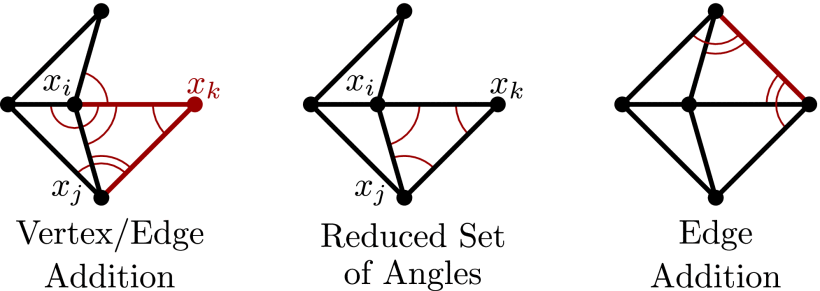
- It's proved that triangulated frameworks are infinitesimally shapesimilar. Theorem 6 and its proof reflect clarifications to the definitions of triangulations and pathology; furthermore, the proof is restructured to emphasize the edge additions that do not increase the rank of the shape-similarity matrix.
Proof:
Details of Proof
The theorem is proved by induction, and for the purpose of this proof,
Consider the triangulation
where
Consider the reduced shape-similarity matrix
where
Replacing
From the construction of the shape-similarity matrix,
The rank of
Such an
Because
To complete the proof, consider additional edges that could be added to
so any edge-additions between vertices in the triangulation do not affect the rank, which was already at its maximum. By induction, triangulations are infinitesimally shape-similar.
Remark 3
The proof of Theorem 6 highlights the importance of the underlying repeated structure of triangulations. In the proof, each additional triangle created through vertex/edge addition increases the rank of the shape-similarity matrix of the triangulation by exactly
A Class of Triangulations
Having established that all triangulations are infinitesimally shape-similar, this section highlights maximally outerplane graphs, a class of triangulations amenable to formation control by multirobot teams in the plane as described in Remark 3.
Definition: maximally outerplane graph
A maximally outerplane graph is a simple plane graph (a plane graph for which there are no parallel edges or loops) for which any edge addition results in a graph which is not an outerplane graph.
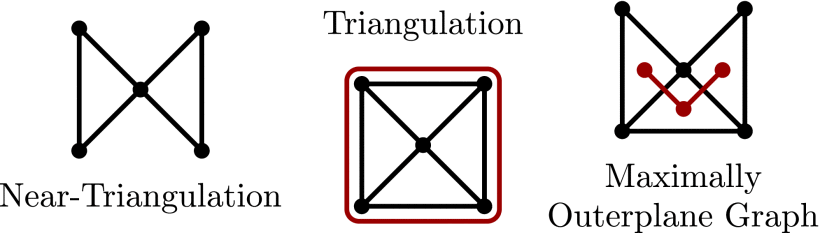
Figure 5 distinguishes maximally outerplane graphs from the broader class of triangulations. Maximally outerplane graphs with at least 3 vertices are triangulations as in the
To construct maximally outerplane graphs, define the graph grammar
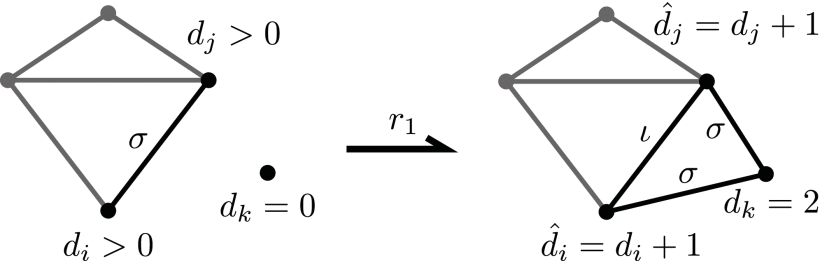
Theorem 7
Let
Proof:
Details of Proof
The theorem will be proved by induction. The connected component of the initial plane graph
Apply
Remark 4
Numerous methods can be employed to produce triangulations:
- using embedded graph grammars;
- Delaunay triangulation of a set of points; etc.
Similarly, there are various procedures for generating maximally outerplane graphs; e.g., ear clipping of certain polygons produces maximally outerplane graphs. The graph grammar
References
- Ian Buckley and Magnus Egerstedt, Infinitesimal Shape-Similarity for Characterization and Control of Bearing-Only Multirobot Formations, IEEE Trans. Robot., vol. 37, no. 6, pp. 1921–1935, Dec. 2021.