
Formations [1]
The task of maintaining a prescribed distance between a pair of agents requires control action. The execution of the task could be the responsibility of both agents or one nominated agent of the pair.
- Modeling using undirected graphs is appropriate in the case of shared responsibility
- The case of single-agent or unilateral responsibility is captured by assigning a direction to the relevant edge in the graph
A directed edge from vertex
Therefore, and advantageously, both the overall communication complexity in terms of sensed or received information and the overall control complexity for the formation are halved in comparison to the shared responsibility case.
The reduction in communication links can mean lower bit rates and reduced difficulties with interference. In the shared responsibility case, a problem can arise when noise is present and two agents fail to share distance estimate information and instead use inconsistent estimates of the distance between each other, but this problem cannot arise in the single-agent responsibility case
Constraint Consistence and Persistence of Formations
Consider conditions involving unilateral distance constraints that ensure that the motions of a formation are restricted to translations or rotations of the formation as a whole.
A notion of persistence is introduced, which is an amalgam of two conditions, specifically, rigidity and a further notion of constraint consistence.
- Rigidity: if certain interagent distances are maintained, then all interagent distances are maintained when the formation moves smoothly
- Constraint consistence: the ability to maintain the specified interagent distances
- NOT constraint consistence: When one agent moves, another agent has an impossible task due to the former agent is unconscious of the constraint
- A 2D graph that has no more than 2 outgoing edges from every vertex is constraint consistent, although there are constraint consistent graphs that possess vertices having out-degree greater than two
A graph can be checked for persistence, that is, rigidity plus constraint consistence, by testing a certain collection of subgraphs for rigidity:
In 2D, Let
In 3D, the same idea applies, except that outgoing edges in excess of
Securing Persistence
Suppose that a 2D undirected graph is rigid. Can we assign edge directions so that it is constraint consistent and thus persistent? The question in its full generality remains open. However, affirmative answers exist for minimally rigid graphs, as well as for graphs with certain structures, including wheel graphs, trilateration graphs, complete graphs, and power graphs of cycle graphs
See Acquiring and maintaining persistence of autonomous multi-vehicle formations for more details
The simplest algorithm for assigning directions in a minimally rigid graph is to consider the associated undirected graph and determine a Henneberg sequence that generates it. Then directions can be assigned to the edges that are added at each step, using the rule that any vertex can have no more than two outgoing edges. Such a directed graph is termed minimally persistent. Minimally persistent graphs are precisely those that are minimally rigid and constraint consistent.
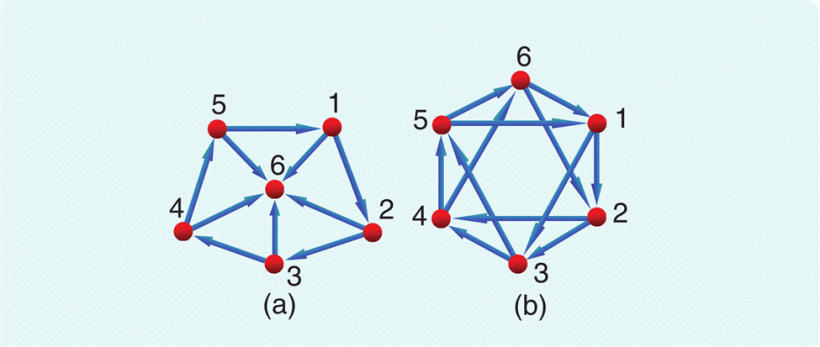
Figure 3 shows some direction assignments for wheel graphs and C
Wheel and C
Henneberg Sequence Theory and Persistent Graphs
The broad conclusion is that the technique can be applied, so long as the primitive operations are modified to allow directed edges in the graphs, and also a further primitive operation is introduced.
More than one operation is possible, with the simplest possible operation being edge-reversal, that is, reversing the direction of one edge arriving at a vertex that has
Definition: degree of freedom(DoF)
In 2D, a vertex is said to have
Extension of the Persistence Concept to 3D Formations
In 3D, most of the consistence and persistence ideas described above carry through. However, these extensions involve the behavior of subsets of agents, as opposed to individual agents or vertices. For
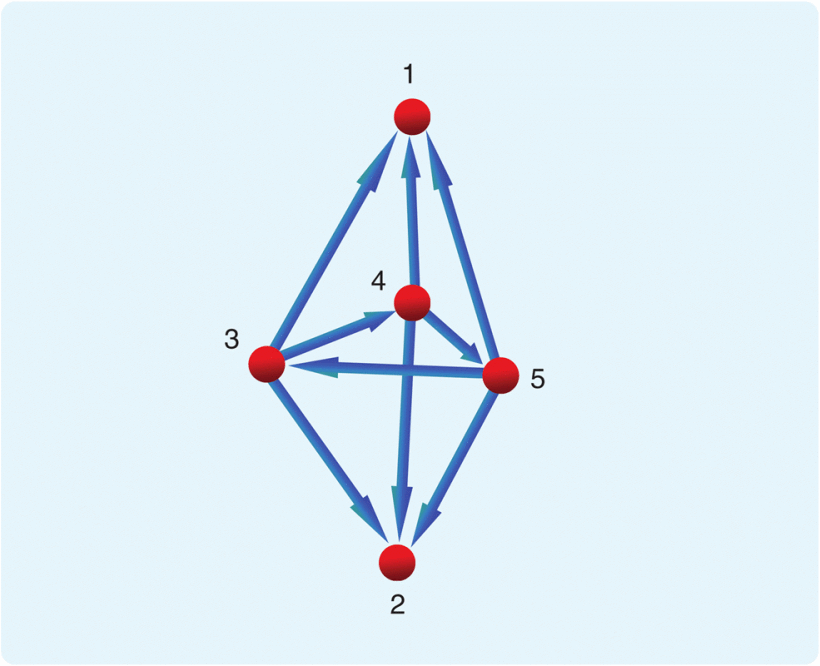
In 3D, checking structural persistence is trivial once persistence has been established. To illustrate structural persistence, Figure 4 depicts a 3D formation with an underlying directed graph, which is persistent since it is rigid and each agent has no more than three outgoing edges. However, agents 1 and 2 are unconstrained, having no outgoing edges, and so in principle can move apart, thus destroying the shape of the formation. Hence, despite the persistence property, this formation is not structurally persistent, and thus does not have a sensing and control architecture that allows retention of its shape
Every 3D graph that has no more than
In particular, the graph is structurally persistent if it is persistent and there is at most
If a graph is acyclic and persistent, it has at most
Operation with formations [1]
Various operations on formations can be contemplated. In particular, the concepts of splitting, merging, and closing ranks are defined for formations that are modeled using undirected graphs.
An application domain where such scenarios arise is terrain surveillance and target localization using a formation of aerial vehicles. The individual vehicles carry sensors performing tasks such as range determination, bearing determination, or time-difference-of-arrival determination.
- In this application, acquiring and maintaining certain formation shapes and hence rigidity is essential because of the need for well-established coordination as well as optimality of certain formation geometries for cooperative localization. Formation shape maintenance within a class of allowable shapes may also be required in scenarios such as avoidance of obstacle collision or of entry into no-fly zones; this may be achieved by splitting, and merging back the split formations once the obstacle or no-fly zone is passed.
- Formation shape adjustment may also be needed for restructuring (closing ranks) to maintain rigidity and form an allowable shape in the event of loss of one or more aerial vehicle agents, or for addition of one or more aerial vehicle agents during a mission to improve surveillance coverage.
Apart from rigidity preservation, the successful execution of these maneuvers requires detailed consideration of agent dynamics (since instantaneous changes of control strategy can produce undesired transient behavior), as well as inclusion of collision-avoidance protection
Splitting
Consider a single rigid formation. Splitting refers to the division of the set of agents into two subsets, along with suppression of the distance constraints between agent pairs when the agents are in different subsets. Reasons for splitting include a change of objective or obstacle avoidance. See Figure 5 for an illustration of the problem.
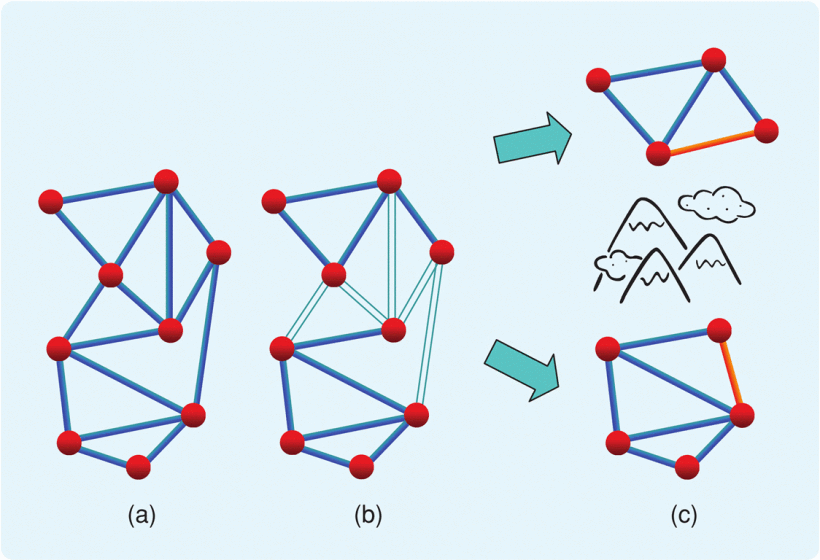
In graph theory terms, the split yields two separate subgraphs, neither of which is guaranteed to be rigid. Introducing additional distance constraints in the separate subformations is thus required to ensure rigidity of each subformation separately.
Additionally, we could consider variations of the problem. For example, we could assume that the starting formation is minimally rigid, we could consider 2D and 3D formations, and we could consider directed graph versions. We could also consider algorithm complexity, as well as the possibility of imposing computational constraints on individual agents to perform calculations on a decentralized basis for determining where additional distance constraints should be inserted. These problems are largely open.
Merging
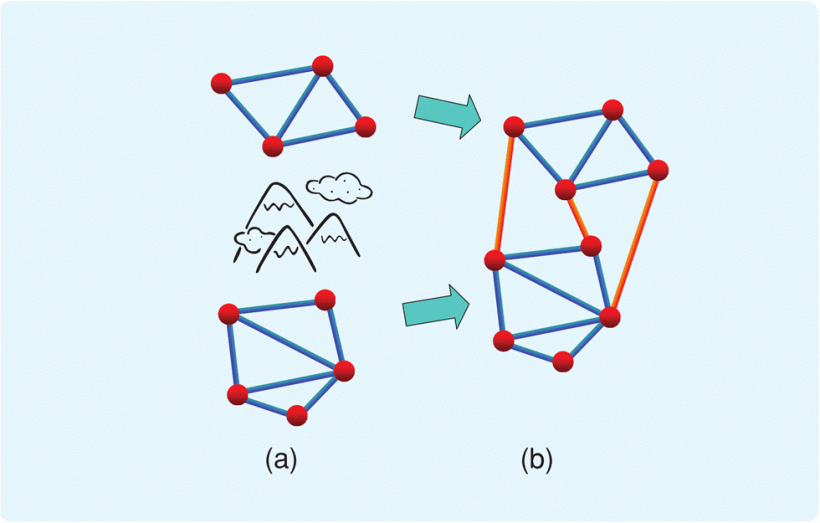
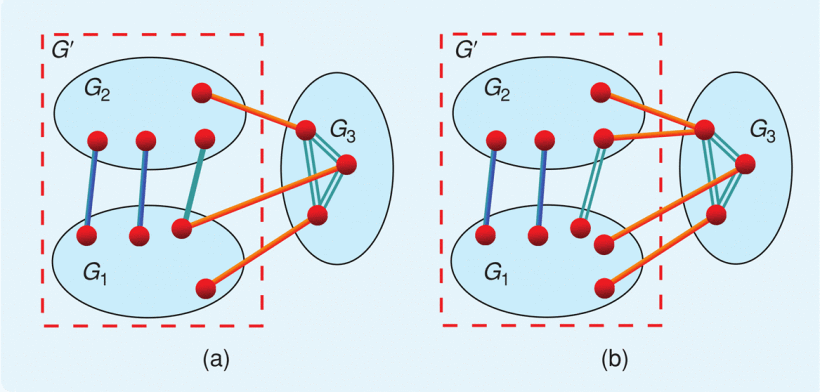
Consider two rigid formations. Merging requires the determination of additional distance constraints linking agent pairs with one agent drawn from each formation, such that the union of the agents of the two formations, along with the union of the distance constraints in the original formations and the new distance constraints, describes a single rigid formation. Figure 6 illustrates the problem.
Closing ranks
Consider a single rigid formation. Suppose that one agent is removed, and, consequently all distance constraints are lost between this agent and the remaining agents of the formation; see Figure 7.
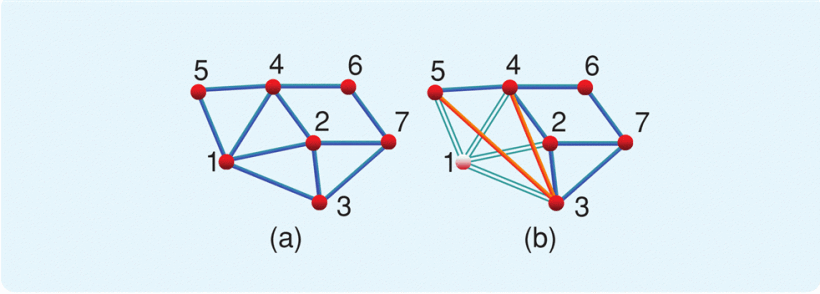
The problem is to determine where new distance constraints can be inserted to recover rigidity. In addition, the closing ranks problem can be generalized to contemplate simultaneous removal of two or more agents from a formation, with the removal also of the associated distance constraints.
A technique is given below for dealing with the problems of splitting, merging and closing ranks.
Technique for dealing with operations
One way to solve these problems depends on a significant modification of the Henneberg sequence and is based on a minimal cover problem. This minimal cover problem presents a graph that is not rigid and for which a minimum number of new edges must be introduced to render the graph generically rigid. The solution of the minimal cover problem can be applied to solve the problems of formation merging, splitting, and closing ranks.
Additionally, the splitting problem is actually a particular case of the closing ranks problem, since one subformation can regard the agents of the other subformation as the lost agents. Further, the closing ranks problem can be solved by introducing new edges between former neighbors of the lost vertices of the graph, i.e., by performing a local repair as illustrated in Figure 7. Therefore, in the splitting problem, new edges can be restricted to connecting pairs of those vertices in one subformation graph that were previously neighbors of vertices that ended up in the other subformation graph, as illustrated in Figure 5.
The formation operations discussed above can also be contemplated for directed graphs
Metavertices, rigid bodies, and Metaformation [1]
In merging two formations, much of the internal structure is largely irrelevant. For example, if two rigid formations are to be merged in 2D, the merging can be done by introducing
Rigidity and 2D Formations of Formations
Body-bar systems conceptually underpin the metaformation view of merging problems. A body is a generalization of a point agent. Any rigid formation of agents can be replaced by a body, a rigid object that in 2D has
A key problem is to determine when such a framework, better termed a metaformation given that it is obtained by interconnecting bodies, is rigid. Of course, we want to answer this problem without accounting for the internal structure of the bodies.
Rigidity is characterized for metaformations of bodies using both a generalization of the rigidity matrix and a generalization of Laman’s theorem for the 2D case. Recall that Laman’s theorem provides necessary and sufficient conditions for generic rigidity of a graph corresponding to a formation of point agents, and the conditions are of a counting form; a simple adjustment of certain numbers appearing in the statement of Laman’s theorem converts the result to a theorem concerning generic rigidity of a graph corresponding to a 2D bodyframework. However, as for checking rigidity of a normal graph in 3D, there is no known necessary and sufficient counting condition in the style of Laman’s theorem for a 3D body-bar framework to be rigid. On the other hand, the rigidity matrix ideas work in 3D space, where the bodies have
Interconnection of two formations involves the interconnection of two bodies, and the extension of Laman’s theorem states
More on Formation Merging
Besides the problem described above of connecting two formations in 2D, several other related problems can be considered:
- connecting, by means of insertion of additional edges, two formations in 3D to secure minimal rigidity
- connecting two formations in 2D / 3D to secure global rigidity
- connecting two formations when they are not disjoint. Nondisjoint formations may have a limited number of common vertices, or a limited number of common edges, or both.
By appealing to various results on rigidity and global rigidity, various conditions are established to solve these problems. These conditions require the insertion of a minimum or exactly specified number of new connections that are incident on a minimum specified number of vertices in each of the two merging formations. We give two examples to illustrate the results.
- Consider two globally rigid 2D graphs, with one vertex in common. By adding two new edges with one vertex in each formation, and such that in at least one of the formations the edges are incident on two distinct vertices, we obtain a globally rigid graph. Note that the two added edges cannot be incident on the vertex common to the two initially given graphs.
- Consider two minimally rigid graphs of 3D formations, with no vertices in common. Merging requires the addition of at least
new edges, with the new edge set incident in each graph on at least vertices. Most patterns involving precisely edges ensure that the merged graph is minimally rigid. Acceptable patterns include every pattern such that each graph has exactly vertices that the new edges are incident on. Each graph can have either new incident edges for each of the vertices, or edges incident on the vertices. A further set of patterns can be obtained using any vertex that has or more new incident edges, by moving one of those incidences to a new vertex in the same graph on which no new edge is yet incident. In this way, up to vertices in each of the two merging graphs can have a new edge incident on it. - A related result is that if the two 3D graphs are rigid but not necessarily minimally rigid, inserting
new edges using the same incidence rules yields a rigid graph. Such an interconnection can be regarded as minimally rigid from the metaformation point of view, since the issue of whether or not the individual metavertices are minimally rigid internally is irrelevant
- A related result is that if the two 3D graphs are rigid but not necessarily minimally rigid, inserting
Directed versions of these results are given in ref. Conditions for securing persistence include the conditions applicable to securing rigidity as discussed above. For example, to merge two minimally persistent graphs in 3D into a larger minimally persistent graph, we need to insert
If the merged graph must be persistent but not necessarily minimally persistent, we need to add
In 3D, if only two agents in the two persistent graphs have positive DoF, then the two graphs cannot be merged into a single persistent graph. However, in every other case, if at least
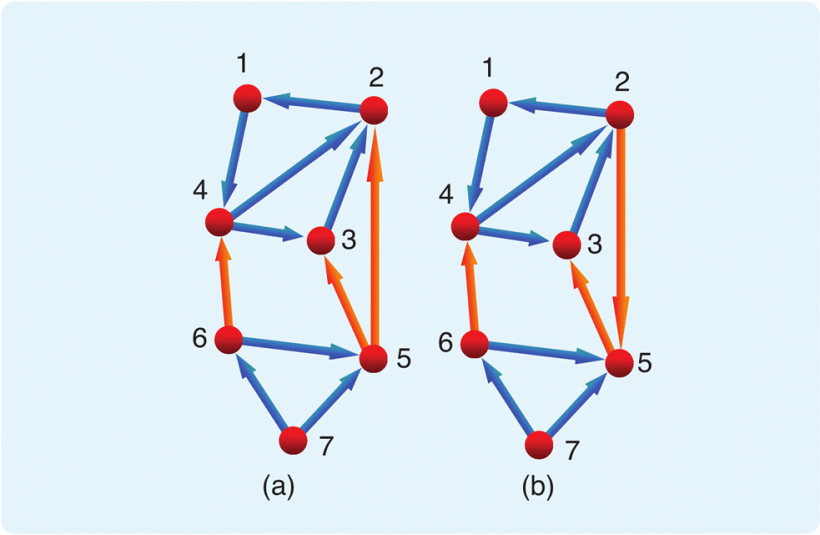
Figure 8 illustrates merging two persistent 2D formations using directed edges. As with undirected graphs, three new edges incident on at least two agents in each formation can achieve the merging. To ensure persistence of the overall structure, the vertices left by these three new edges must have in the merged structure a maximum out-degree of
For 3D formations, structural persistence of the merged formation is also desired. Requirements are set out in ref
Toward a More Systematic Theory
In 2D we have described a variation of Laman’s theorem describing the rigidity of a metaformation, obtained by connecting together metavertices or meta-agents. This result leads to the question of whether the concept of a Henneberg sequence can be extended to metaformations. Such a sequence could start with a single metavertex, or rigid formation, and involve the successive addition of meta-agents to the metaformation. Each addition would result in a metaformation that has the minimal number of edges between metavertices so as to guarantee rigidity of the overall metaformation. Indeed, such a construction is available. Analogues to the primitive operations of the standard Henneberg construction, namely, vertex addition and edge splitting, can be constructed. These operations are termed metavertex addition and metaedge splitting, respectively. See, for example, Figure 9. The construction can also be described by building on the results described in the previous section.
References
- B. D. O. Anderson, C. Yu, B. Fidan, and J. M. Hendrickx, Rigid graph control architectures for autonomous formations, IEEE Control Syst. Mag., vol. 28, no. 6, pp. 48–63, Dec. 2008.